December 2025: "I know your face", SuperBob & the SuperHome
December 15, 2025
Well… that’s almost another year wrapped up. Just as we were starting to power down for the holidays, news broke of the awful act of terror at Bondi Beach. Our CTO lives only a few kilometers away, and like many, there was a moment of real concern, followed by relief to learn he was nowhere near the area at the time. Our thoughts are very much with those affected, their families, and the wider Bondi community.
It’s a somber way to see out the year, and a sharp reminder of what really matters. As we head into the break, we genuinely hope all our followers, users, partners, and friends are able to find a bit of peace, rest, and time with the people they care about.
The executive summary for those that have just 15 seconds: We won an award, we presented on the first net zero superhome (cheat sheet — it easily achieved net zero), we got recognised in a packed room, we are 99% complete our on app refresh.
Thanks for being part of the journey, and for sticking with us through another big year.
👀 2025 Reflection

We’ve been wrapping things up here at nezo, reflecting on what’s been a pretty tough year for climate action and construction in New Zealand. That said, we’ve been anything but quiet.
Last Christmas we jokingly gave the NZ Government a piece of coal. Honestly, we didn’t think they’d find a bigger shovel in 25, but here we are. So yes, coal it is again for PM Christopher Luxon, Building Minister Chris Penk, and Climate Minister Simon Watts.
The most consequential rollback wasn’t subtle: the Building for Climate Change programme was effectively dismantled, the specialist team reduced to a skeleton (we believe its not even 0.5 FTEs), and the carbon roadmap stripped of its planned mandates for embodied-carbon measurement and reduction, and relegation to the Christopher Luxon “I don't care” pile.
For the construction sector, it removed the clearest indication that carbon reduction matters — keeping in mind the market wanted this. For us at nezo, it slowed market pull and made it harder (for now) to prove what we know to be true: decarbonisation is actually easy, and a genuine competitive advantage, when embedded early and consistently, alongside cost.
Add funding cuts, softened ETS settings, and delayed public-sector targets… and yes, it’s been a year. But we’re still here (when our competitors folded), because physics, finance, and global direction haven’t changed, even if policy temporarily has.
So we adapted. And bloody quickly too.
We came back in January and launched WEB: Weight, Emissions & Budget, our consultancy arm, knowing that some developers still wanted (and needed) help achieving better cost and carbon outcomes, regardless of legislation.
At the same time, we pivoted our first scalable market to NSW, reading the legislation carved in stone by a stable government. SEPP reforms and NABERS momentum gathering pace. Shortly after, we joined Creative HQ’s Aurora Climate Lab, genuinely a game-changer. They helped us sharpen our strategy, pressure-test our pivots, and completely rethink how we talked about nezo (then still called V-Quest).
The big shift? Lead with cost reduction and weight opportunity, with decarbonisation as the powerful add-on. In this climate, cost comes first, carbon follows intuitively when it does. They also helped us shed our legacy name and step fully into ηezo (η for efficiency we bring to eliminating carbon without adding cost).
Through the year, we stayed close to our NZ users, asking what was working, what wasn't, and what they actually needed to see added. The feedback was clear: make materials easier to find, let users build their own systems, add H1 (NZ) compliance and energy modelling, and make the platform feel lighter. Most of that is now done.
And then there’s Australia.
Looking across the Tasman, especially to NSW, the difference is stark (a ✅ from nezo in their stocking this year). SEPP-led planning reforms, clearer consent-stage requirements, strong electrification signals, and growing expectations around whole-of-life performance.
The NABERS Embodied Carbon Tool has become the reference framework — practical, consistent, and increasingly unavoidable on major and government-led projects. We are also hearing through our friends at NABERS that work is already underway to broaden the legislation to a national level via the National Construction Code (NCC).
Gas is also on the way out, all-electric is in, and future-proofing is no longer optional. That combination creates real market pull — the kind that gives startups like ours oxygen.
Which is why we opened an office in Sydney’s Salesforce Tower, started building relationships with local architects and institutes, ran live demos across NZ and Australia, and collaborated with the MPI-backed Mid-Rise Wood Construction Programme on a free early-stage cost and carbon tool.
It’s been a year of survival while others quietly disappeared. A year of pivots, late nights, early mornings, and plenty of “laugh or you’ll cry” moments. But heading into 2026, we’re optimistic. The groundwork is done. The product is stronger. The market is ready and opportunities in markets like the UK and South East Asia are opening up for us. Hard work ahead in 2026, but we’re ready for it.
☕ Out & About

As usual, we’ve been out there on the ground this month, talking to as many movers, shakers, users, and occasional abusers as we can find. Trying to convince the unconvinced, uncover the quiet users, and generally make enough noise that it feels less like shouting into the void. And honestly, it’s the small moments (and the odd big one) that remind us it’s working.
Case in point: at the Art Centre tenants’ Christmas party (our office home), an architect recognised our CEO from our LinkedIn posts and demo videos. What followed was a passionate, slightly animated conversation about the industry, its flaws, where it’s heading — and, of course, Christmas plans. The best part? It’s now turned into a one-on-one demo with Peddlethorp Architects lined up for January 2026. Proof that posting into the algorithm abyss does occasionally come back.
It wasn’t the only highlight. We were one of six companies commended by the Sustainable Business Network at their annual awards — no small feat given there were 119 finalists, with the built environment more represented than any other sector. There were only two awards on the night (Leader and Disruptive Innovation), and while we didn’t take home the trophies, making the final six felt like a solid nod that we’re onto something.
We were also interviewed by Business Post about our plans for 2026 and how data can help unblock lower-carbon construction and the mass-timber industry. Always nice when someone else writes the words for a change. (Link included for anyone keen.)
We also squeezed in a virtual meeting with Frankie L'Estrange, ASB’s Head of Sustainable Finance. Fast-paced, straight-to-the-point, and refreshingly aligned. Frankie fully gets that if carbon assessment is going to scale, it has to be easy — friction is the enemy. He was genuinely excited to see a tool like Nezo that integrates carbon and cost, and we came away seeing some very real opportunities for collaboration and developer-led outcomes down the track.
All up? A busy month. Plenty of conversations. A few wins. And enough momentum to remind us we’re not shouting into the darkness, we’re building something people are starting to hear.
🧑💻 Users News

We helped SuperBob achieve super carbon results on a SuperHome
For the last few months Bob Burnett architecture and the Superhome Movement have been using nezo to analyse their SuperHome design for a development of 4 residential high performance homes in Somerfield, Christchurch, New Zealand. Ngā Whare Pārara.
For those not familiar, a SuperHome sets out stages of operational efficiency against your budget. The Base → Better → Best Framework. Translation: high performance, low air loss staged designs. The aim — normalise better buildings rather than treat them like unicorns.
We were invited to speak at the Superhome Expo on Friday 12 & Saturday 13th at the site, with houses in construction. It was an event proving that efficient, high-performing homes don’t have to blow the budget.
Through WEB, we’ve been supporting what’s set to become New Zealand’s first Net Zero-carbon SuperHome. Our job was simple: help hit Net Zero without terrifying the spreadsheet.
The numbers delivered:
32,750 kg CO₂e embodied emissions,
41,914 kg CO₂e biogenic storage —
about 9 tonnes more carbon stored than emitted at construction.
Compared to a typical NZ home, that’s roughly 29 tonnes CO₂e better overall, and yes — all within cost constraints.
The changes they made were simple but effective:
• Raised suspended timber floors
• Low carbon concrete where necessary
• Timber (Heat & Acetyl treated) facades
• uPVC Windows & Doors
The foundations alone would have been 8,000kgs higher in carbon emissions, with low carbon concrete. The numbers speak for themselves.
⚙️ Features, Features, Feature
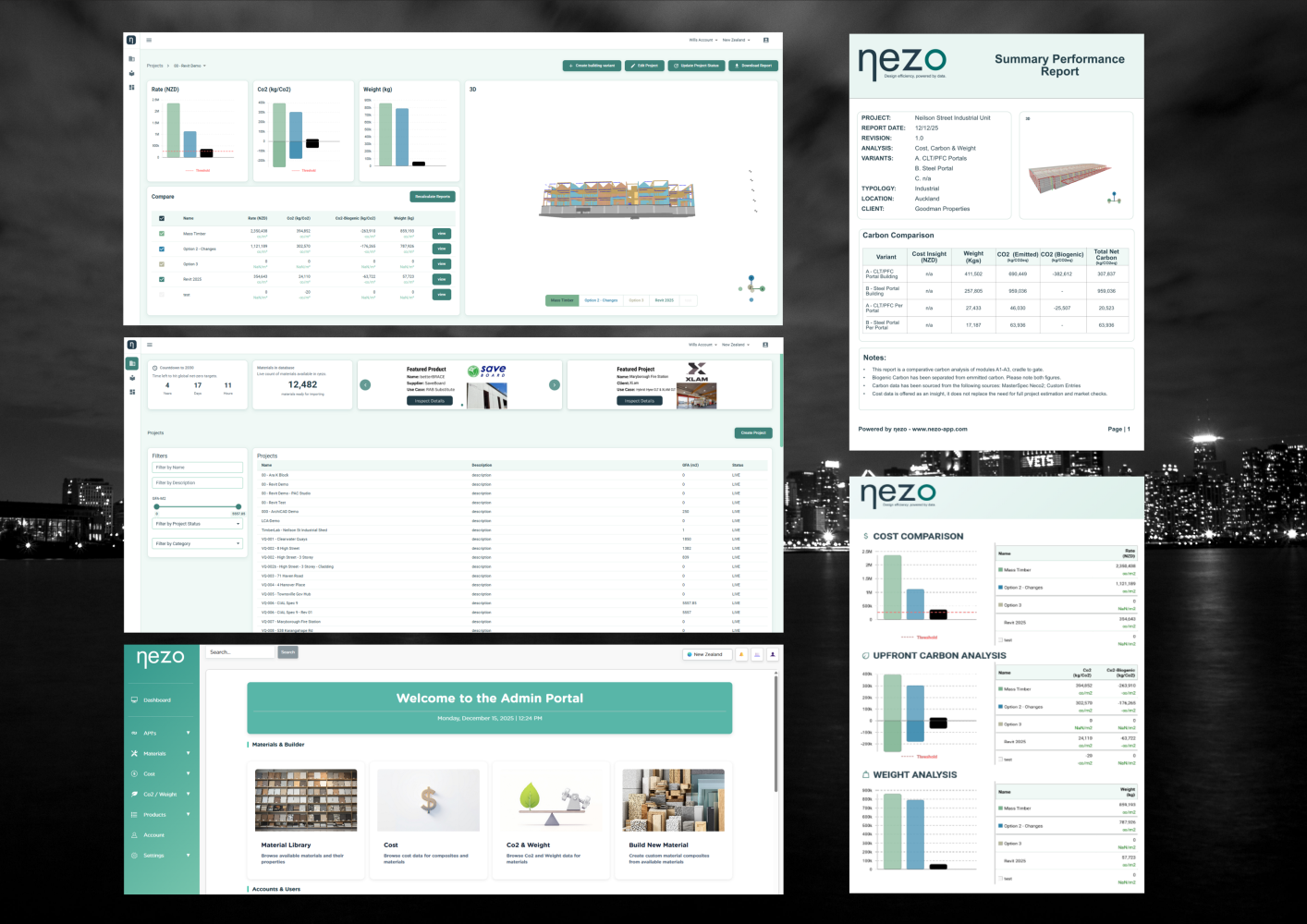
We’ve mentioned the app facelift a few times now, but we’re officially in beta testing 🎉. A group of brave (and very honest) users are putting the new look and layout through its paces, and so far the feedback has been overwhelmingly positive. It’s brighter, lighter, more professional, and most importantly, easier to use. Same brain, much better haircut.
Alongside the glow-up, there are some proper feature upgrades worth calling out:
H1 HUB is our polite but firm response to the messy, manual chaos that is most existing H1 calculators. Instead of wrestling spreadsheets and second-guessing inputs, the H1 Hub pulls R-values straight from your design, pre-populates the data for you, and only asks for a handful of genuinely necessary variables (yes, things like roof-edge insulation but massively simplified).
The result? A fully compliant H1 report in about five minutes, not five coffees. No data re-entry, no calculator gymnastics, no wondering if you’ve ticked the right box three screens back. Development is nearly complete, with a January release locked in, and we’re quietly confident this one’s going to save a lot of sanity.
The Dashboard: The old placeholder dashboard has been politely retired. In its place is a rotating information board that actually earns its keep. You’ll now see a countdown to 2030 (our first climate target), live data summaries, featured products, and real case studies. Search is faster, filters are smarter, and project summaries are clearer. The goal? Help you stay up to date with what’s on the market, learn from peers, and keep an eye on what we’re all collectively trying to achieve.
Ops Console (working title, name suggestions on a postcard please): This one’s a big deal. The Ops Console lets you fully explore the data inside ηezo — total transparency. You can interrogate existing materials and systems, then piggyback off that data to build your own custom materials and assemblies that suit your project. Those get saved into your own material database. In short: more control, better data, fewer compromises.
Exports (now doing some heavy lifting): We’ve added a NABERS export alongside our Green Star and LCAQuick exports, taking a lot of manual pain out of reporting. There’s also a new Excel export, and a significantly refreshed PDF report — clearer, cleaner, and client-presentation ready.
The little things that matter: You can now set your project status (live, archived, complete), get notifications, and chat directly with us and your team inside the platform. Small features, big quality-of-life upgrades.
All up, it’s great momentum heading into 2026. Plenty more coming — but the thing we’re most excited about next? Energy modelling. 🚀
🌍 World News

Normally this is where we sound like a broken record and run through the piss-poor performance of the New Zealand Government on climate action, mitigation, and resilience. But if you’ve read the reflections above, you already know how that story goes, so we’ll spare you the encore.
Yes, there’s an election in 2026. No, there isn’t much time left to undo two years of fairly catastrophic unforced errors. We’ll leave that there.
So, without further ado, here are a few stories that show how the rest of the world is quietly (and not so quietly) getting on with it — building, investing, and decarbonising, with or without New Zealand.
• Iran is enduring one of its worst droughts in decades; the capital could face critical water shortages and possible evacuation plans as reservoirs drop and rationing is discussed. The crisis is linked to prolonged drought conditions made more frequent and severe by climate change, plus long-term water-management issues.
• CarbonCure concrete technology spotlight — Industry leaders discuss how plants can reduce embodied carbon using proven carbon-reduction tech, highlighting adoption strategies for contractors. For Construction Pros
• First full-scale UK carbon capture facility for cement — MHI and Worley are building a facility at Heidelberg Materials’ Padeswood plant to capture ~800,000 tonnes of CO₂/year, a major step for decarbonising one of construction’s most carbon-intensive materials. Mitsubishi Heavy Industries, Ltd.
• Irish Green Building Council says building industry ready to decarbonise — An industry report emphasises that the sector is prepared but needs strong guidance and regulation to meet climate targets. Engineers Ireland
• EU policy push for low-carbon industrial products — Recommendations for harmonised embodied carbon labelling and decarbonised product categories could drive demand for low-carbon building materials. Clean Air Task Force
• Scientific real-time emissions monitoring in construction — A data-driven system uses wireless sensors to track machinery emissions, providing high-resolution data to improve reporting and optimisation on sites. Nature
🪶 Feliz Navidad Amigos
In 2024 they told us “Survive to 25”, then to grind through 25, now we hope to sprint to 26.
The world keeps wobbling, policy keeps shape-shifting, and we’re all just doing our best not to spill the tea while the table legs get shorter. Rest where you can, laugh at what you must, and remember that momentum doesn’t always look like speed — sometimes it just looks like staying upright until your legs come back.
That’s our news for December and for 2025. Go rub a dog, bow to a cat or pirouette to a pigeon. Life is short, so why not.
See you all in 2026.
Team ηezo